
SAP FICO Course in Bangalore: FI & CO Modules, Syllabus, Fees & Jobs

SAP FICO course in Bangalore is among the most sought options for commerce graduates, accountants and finance professionals making a career shift towards SAP. SAP FICO is the finance domain within SAP’s ERP suite: its FI (Financial Accounting) records a company’s revenues and expenses, and its CO (Controlling) tracks costs and profitability. This article talks about what SAP FICO is, the content of the FI and CO modules, the syllabus, factors influencing the fees and career prospects to help you decide before you enroll.
What Is SAP FICO?
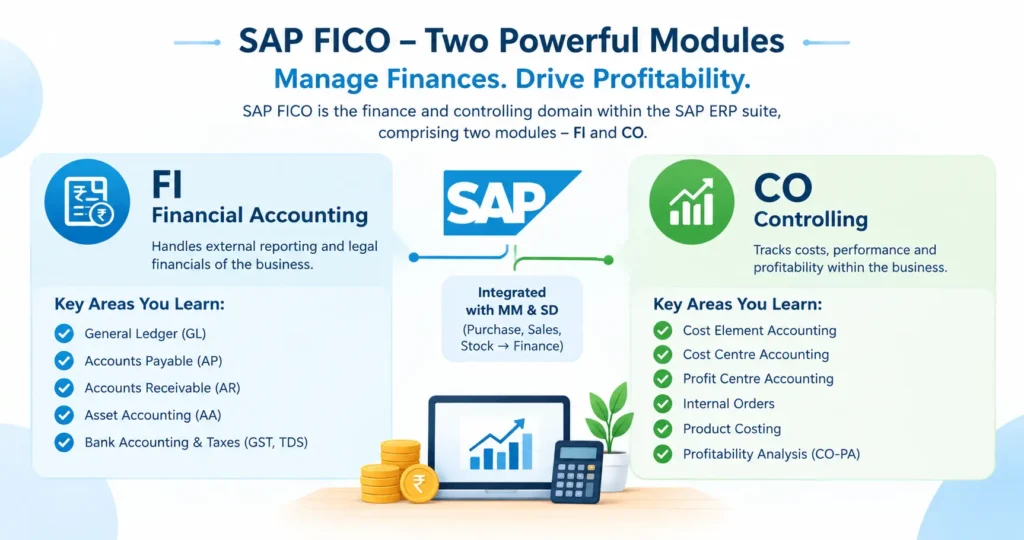
SAP FICO is the finance and controlling domain within the SAP ERP suite. It is comprised of two modules: the SAP FI for external reporting and the SAP CO for internal cost and profitability tracking. Organizations use it to manage their ledgers, payments to vendors, receivables from customers, year-end closing and to understand what is contributing to their profitability.
SAP FICO is a functional module which means that you configure business processes and collaborate with finance teams, and do not have to write code. As all purchase, sales and stock movement processes in SAP eventually go into finance, it is closely integrated with the SAP MM and SD modules. This is why SAP FICO consultants continue to be in demand across a variety of projects.
SAP FI Module: What You Learn
The FI (Financial Accounting) module is focused on legal aspects of a business’ finances, and is used to generate the balance sheet, profit and loss statement and other reports needed by auditors and tax authorities. In a good SAP FICO course in Bangalore, the FI syllabus goes into the following:
- General Ledger (GL): Chart of accounts, posting rules, document types and period-end month-end closing.
- Accounts Payable (AP): Processing of vendor invoices, payments and the payment run.
- Accounts Receivable (AR): Processing of customer invoices, incoming payments and dunning.
- Asset Accounting (AA): Asset creation, depreciation and retirement.
- Bank accounting and taxes: Bank reconciliation and Indian taxes such as GST and TDS.
Each topic is practiced by posting real entries in an SAP system through hands-on exercises.
SAP CO Module: What You Learn
CO is the management accounting module, used to answer questions such as which business unit is overspending, which product is most profitable and how much a project is costing. The SAP FICO course syllabus on the CO side typically covers:
- Cost element accounting: Linking of cost elements to SAP FI accounts.
- Cost centre accounting: Budgets and costs for various departments.
- Profit centre accounting: Profits by business unit or geographical location.
- Internal orders: Tracking cost of a specific event.
- Product costing: Cost calculation for a product.
- Profitability analysis (CO-PA): Profit by customer, product and other dimensions.
| SAP FI | SAP CO | |
| Focus | External and statutory reporting | Internal cost and profit analysis |
| Main output | Balance sheet, P&L, tax reports | Cost reports, budgets, profitability |
| Used by | Accountants, auditors | Finance controllers, managers |
SAP FICO Syllabus: Module-by-Module
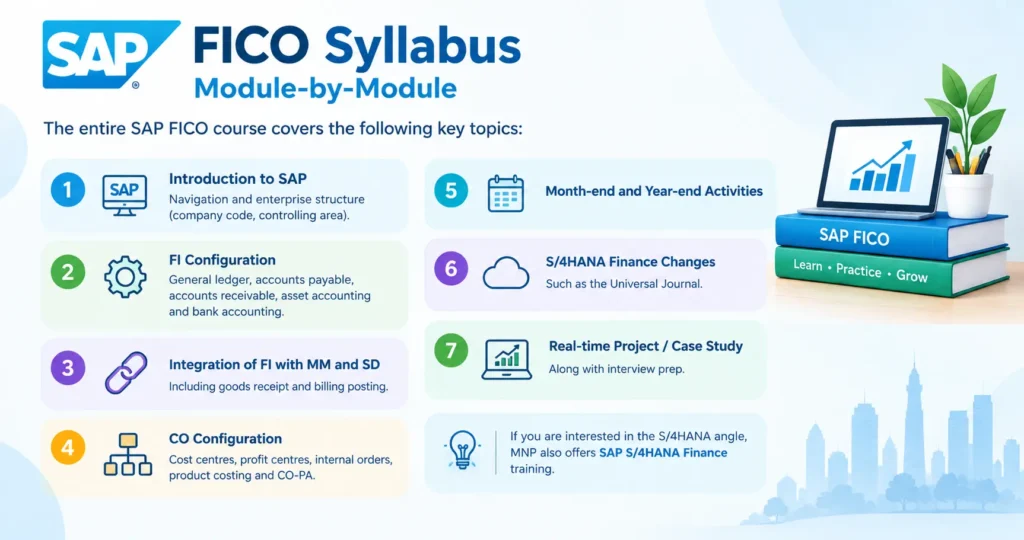
The depth of the SAP FICO syllabus varies between institutes, so compare the topics covered before signing up based on the course title. The entire syllabus for SAP FICO course would typically include:
- Introduction to SAP, navigation and enterprise structure (company code, controlling area).
- FI Configuration: General ledger, accounts payable, accounts receivable, asset accounting and bank accounting.
- Integration of FI with MM and SD, including goods receipt and billing posting.
- CO Configuration: Cost centres, profit centres, internal orders, product costing and CO-PA.
- Month-end and year-end activities.
- S/4HANA finance changes, such as the Universal Journal.
- Real-time project or case study, along with interview prep.
If you are interested in learning more about the S/4HANA angle, MNP also offers SAP S/4HANA Finance training.
Who Can Learn SAP FICO?
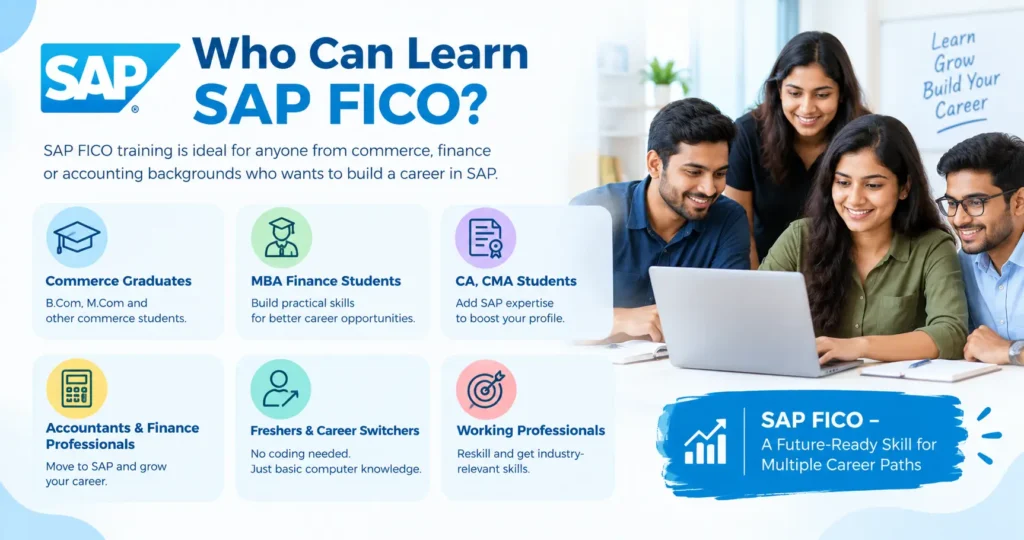
Anyone searching for a SAP FICO course in Bangalore would come across a range of candidates who come seeking SAP FICO training: commerce graduates, B.Com and M.Com pass-outs, MBA Finance students, CA, CMA students, accountants and finance executives. Since SAP FICO is a functional module, freshers and those looking to reskill can jump in right away, without coding or technical skills. Having conceptual accounting knowledge of debit, credit and ledgers would accelerate understanding, but is not mandatory.
Not sure if FICO is the right module for you? Read which SAP module to learn to compare FICO, MM, SD and ABAP.
SAP FICO Course Duration and Training Modes
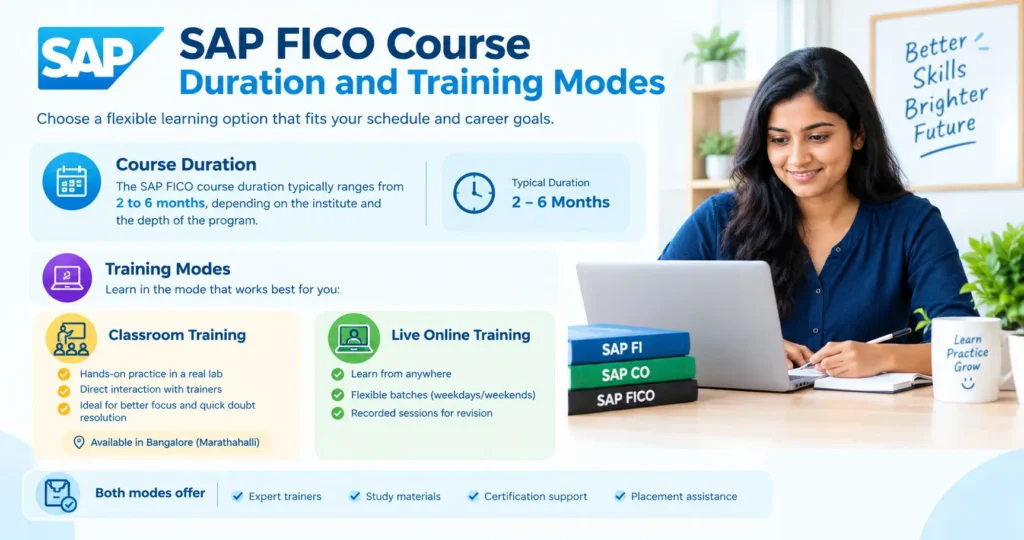
MNP Technologies lists its SAP training at 10-12 weeks, with weekday and weekend batches and a choice of classroom and live online learning. Other institutes follow similar training patterns:
- Classroom: Direct access to the trainer and lab time, suitable for freshers and students looking for an offline SAP FICO course in Bangalore.
- Live online: Suitable for working professionals who cannot relocate. Many learners are looking for a SAP FICO online training in Bangalore for this reason.
- Fast-track: Shorter duration, but longer hours per day.
When comparing the SAP FICO course duration and fees at different institutes, it is advisable to look at total training hours instead of weeks.
SAP FICO Course Fees in Bangalore: What Affects the Cost
Many learners question how much a SAP FICO course costs in Bangalore. To a certain extent, it is subjective as SAP FICO course fees in Bangalore vary with a few factors:
- Type of batch: Classroom, live online or fast-track.
- Duration and total hours: Courses with more hours for practice are usually longer.
- Inclusions: SAP system access, material, projects and resume support.
- Trainer experience: Consultants with live project experience may charge more.
SAP FICO training fees in Bangalore can look similar on a poster, but can differ significantly when you delve into what is included. Request a written fee breakup. If you are a fresher looking for SAP FICO course fees for freshers, ask if there is a student batch.
Be wary of fee offers tied to placement. SAP FICO course fees with placement support must clearly outline what this entails, such as resumes, mock interviews, referrals and no job guarantees.
Certification cost: The SAP FICO certification cost in Bangalore is usually separate from the course fee. The exam is booked and paid for with SAP, and the price can vary, so confirm in writing if any exam voucher is included in the package.
For MNP’s current fee, contact the admissions team via the SAP FICO course page.
What a Good SAP FICO Course Should Include
A good SAP FICO course in Bangalore should include more than theory. Look for:
- Live SAP system access to practice each posting.
- Real-time projects: SAP FICO real time projects training in Bangalore should guide through a complete cycle, from invoice posting to month-end closing.
- Experienced trainers with implementation or support project experience.
- Small batches to clear doubts.
- Interview preparation: Resume building, mock interviews and scenario questions.
A demo class is the best way to assess all this before you pay.
SAP FICO Career Scope in Bangalore
Bangalore is home to many IT services companies, global capability centres and finance operations teams that run on SAP. Additionally, companies are shifting towards S/4HANA, which has increased demand for people with SAP finance skills.
Typical entry-level job titles include SAP FICO support analyst, junior SAP FICO consultant, SAP finance analyst and finance executive with SAP knowledge. With experience, you can transition into senior level roles such as consultant, functional lead and finance transformation leader. Titles and opportunities vary with organizations, so research current job openings in Bangalore before enrolling.
Is SAP FICO worth the fees in 2026? It can be, if the training includes hands-on practice and interview preparation. For a deeper look into job prospects, SAP FICO a good career for freshers and non-IT professionals.
How to Choose the Right SAP FICO Institute
Searching for SAP FICO training and placement in Marathahalli, Bangalore leads to many coaching centres offering a SAP FICO training institute in Bangalore, claiming to be the best. Search results are filled with “best SAP FICO training institute in Bangalore with 100 placement.” Treat these with caution. A better way to shortlist is to attend a demo and ask each SAP FICO institute in Bangalore:
- Who teaches and how many years of experience on real projects?
- Is there a live SAP server and how many students share it?
- What is the batch size and the fee breakup?
- How does placement support work?
- What is the refund or batch change policy?
SAP FICO opens up a clear career path in finance technology, whether you are a fresher or an accountant looking to transition. Decide on the module, compare the syllabus, ask for the fee breakup and attend a demo. When you are ready, explore MNP’s SAP FICO training in Bangalore and book a free demo class to get the fee breakup.
FAQs
-
How much does a SAP FICO course cost in Bangalore?
Fees vary between institutes, batch type (classroom, live online or fast-track), duration, inclusions such as SAP system access, projects and placement support. Ask for a written fee breakup and compare what is included, not just the headline price. For MNP’s current fee, contact the admissions team.
-
What is usually included in SAP FICO course fees?
Most programs include live training sessions, access to an SAP practice system, study material and a hands-on project or case study. Resume and mock-interview support is common. The SAP certification exam fee is usually separate, so confirm each item before paying.
-
How long does a SAP FICO course take?
MNP Technologies lists its SAP training at 10-12 weeks, with weekday and weekend batches. Duration varies with daily class hours and whether the plan is fast-track at other institutes, so compare total training hours rather than months.
-
Is the SAP FICO certification cost included in the course fee?
Usually not. SAP certification exams are booked and paid for separately with SAP, and the cost can vary. Institutes normally prepare you via training and practice questions. Confirm in writing whether any exam voucher is included in the package.
-
Can a commerce or non-IT graduate learn SAP FICO?
Yes. SAP FICO is a functional finance module, so no coding is needed. A background in accounting, commerce, CA or CMA studies helps you pick up concepts faster, but freshers and career switchers can start from the basics.
-
Is SAP FICO worth the course fees in 2026?
SAP finance skills remain relevant as many companies run finance on SAP and are moving to S/4HANA. Whether the fee is worth it depends on training quality, hands-on project exposure and your interview preparation. Attending a demo class and reviewing the syllabus is recommended.
-
What should I check before paying for a SAP FICO course in Bangalore?
Check trainer experience on real projects, whether you get live SAP system access, batch size, syllabus depth, how placement support works, and the refund or batch change policy. Attending a demo class is the simplest way to assess this before paying.

